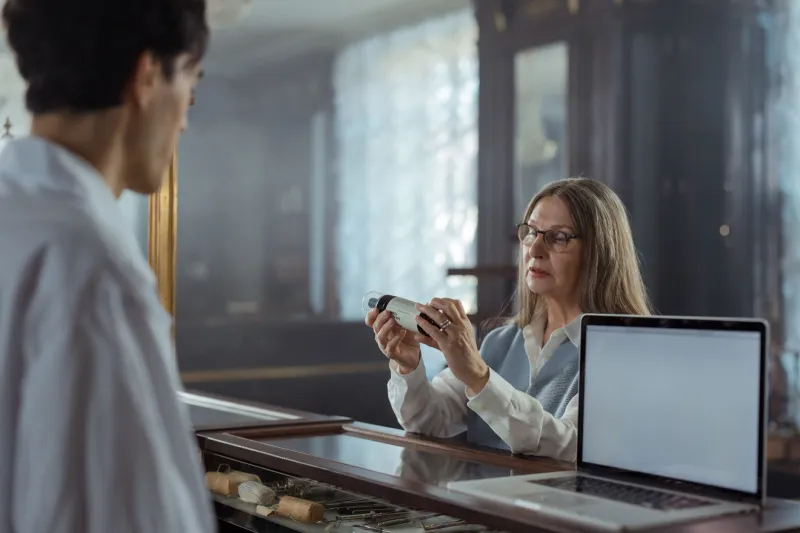
Lost in Translation: Why Language Barriers at the Pharmacy Counter Are a Public Health Crisis — and How Multilingual Support Changes Everything

Every year, tens of thousands of Americans are harmed by preventable medication errors. Among the most vulnerable are the roughly 67 million residents of the United States who speak a language other than English at home — a population that navigates the complexities of the healthcare system with one hand effectively tied behind their back. At the pharmacy counter, where precise communication can mean the difference between recovery and a medical emergency, this disadvantage becomes acutely dangerous.
The problem is not a matter of intelligence or effort. It is a structural failure — one that a multilingual pharmacy model, long standard practice across much of Europe, is uniquely equipped to address.
The Hidden Danger Behind the Prescription Label
Consider what happens when a Spanish-speaking grandmother in Miami is handed a bottle of blood pressure medication with instructions printed exclusively in English. Or when a Mandarin-speaking recent arrival in San Francisco tries to understand a pharmacist's verbal warning about a potentially dangerous interaction with a supplement he has taken for decades. The communication gap in these scenarios is not merely inconvenient — it is medically consequential.
Research published in the Journal of General Internal Medicine has consistently found that patients with limited English proficiency are significantly more likely to experience adverse drug events than their English-fluent counterparts. A 2021 analysis by the Agency for Healthcare Research and Quality identified language barriers as an independent risk factor for medication non-adherence, incorrect dosing, and delayed recognition of side effects. These are not abstract statistics. They represent real people — parents, grandparents, working adults — whose health outcomes are compromised by a system that was not designed with them in mind.
US pharmacies are legally required under Title VI of the Civil Rights Act to provide language access services when they receive federal funding, yet enforcement is inconsistent and the quality of available translation services varies enormously. Many chain pharmacies rely on telephone interpreter lines that are ill-suited to the nuanced, time-sensitive nature of pharmaceutical counseling. A pharmacist explaining the titration schedule for a diabetes medication through a third-party interpreter on a speakerphone is not the same as a trained pharmaceutical professional conversing fluently in a patient's native tongue.
How European Pharmacy Culture Embeds Multilingualism as Standard Practice
Across the European Union, multilingualism is not an accommodation — it is an expectation. With 24 official languages and hundreds of regional dialects spoken across the continent, European pharmacies have developed robust systems for serving linguistically diverse populations as a matter of routine professional practice.
Pharmacists trained within the EU are frequently required to demonstrate proficiency in multiple languages as part of their academic and professional credentialing. In countries such as Luxembourg, Belgium, and Switzerland — where two or more official languages are spoken — pharmacy consultations conducted in the patient's preferred language are the norm rather than the exception. This model extends naturally to the digital pharmacy environment, where multilingual customer support is built into the service architecture from the ground up.
At EuFarmacie Online, this European standard is reflected in the breadth of languages available for patient consultations. Whether a customer's primary language is Spanish, Portuguese, Polish, Romanian, or Arabic, trained pharmaceutical professionals are available to discuss prescriptions, clarify dosing schedules, flag potential drug interactions, and answer questions about storage and administration — all in the language the patient understands best.
Stories from the Front Lines of Pharmaceutical Communication
The stakes of this issue become vivid when examined through individual experience.
A Vietnamese-American patient in Houston, managing both hypertension and a chronic pain condition, had been self-adjusting the timing of her medications based on a misunderstanding of her pharmacist's instructions — instructions she had nodded along to without fully comprehending. It was only during a consultation with a Vietnamese-speaking pharmaceutical advisor through a European online pharmacy service that she learned she had been inadvertently amplifying the blood pressure-lowering effect of one drug by taking it simultaneously with a pain reliever that compounded its action. The error, uncorrected, carried a genuine risk of hypotensive episodes.
In another case, a Polish-speaking construction worker in Chicago had been doubling his prescribed antibiotic dose under the mistaken belief — drawn from an incomplete translation of the label — that "twice daily" referred to the number of pills per dose rather than the frequency of administration. A pharmacist who spoke Polish fluently identified the misunderstanding within the first two minutes of a consultation call and corrected the course of treatment before serious gastrointestinal harm occurred.
These are not edge cases. They are representative of a daily reality for millions of Americans who deserve pharmaceutical care that meets them where they are — linguistically and culturally.
Beyond Words: The Cultural Dimension of Pharmaceutical Counseling
Language competence alone does not fully capture what effective multilingual pharmacy support requires. Culture shapes how patients understand illness, interpret medical authority, and make decisions about treatment adherence. A pharmacist who speaks a patient's language but lacks cultural fluency may still fail to communicate effectively.
European pharmacy professionals, many of whom work within or emigrated from culturally diverse communities, often bring a level of cultural sensitivity to consultations that purely transactional translation services cannot replicate. Understanding, for instance, that certain immigrant communities have deep-seated hesitancy about psychiatric medications — or that traditional herbal remedies common in one culture may carry significant interaction risks with Western pharmaceuticals — allows a pharmacist to counsel with both precision and empathy.
This culturally informed approach is particularly relevant for immigrant communities in the United States, where health disparities along linguistic and ethnic lines remain stubbornly persistent despite decades of public health intervention.
A Structural Solution to a Structural Problem
Addressing language-based medication errors requires more than goodwill or improved signage at the pharmacy counter. It demands a structural commitment to multilingual competence at every point of the pharmaceutical care pathway — from prescription intake to dispensing to follow-up consultation.
The European pharmacy model, as offered through platforms such as EuFarmacie Online, demonstrates that this commitment is achievable and scalable. By extending access to licensed pharmaceutical professionals who can counsel patients in their native languages, these services effectively close a gap that the traditional US pharmacy system has long struggled to bridge.
For the millions of non-English-speaking Americans who currently navigate their medication regimens in a state of partial comprehension, that gap is not merely a matter of convenience. It is a matter of safety — and ultimately, of life.
EuFarmacie Online provides multilingual pharmaceutical consultations and access to European-licensed medications for patients across the United States. All consultations are conducted by qualified pharmacy professionals in compliance with applicable regulatory standards.